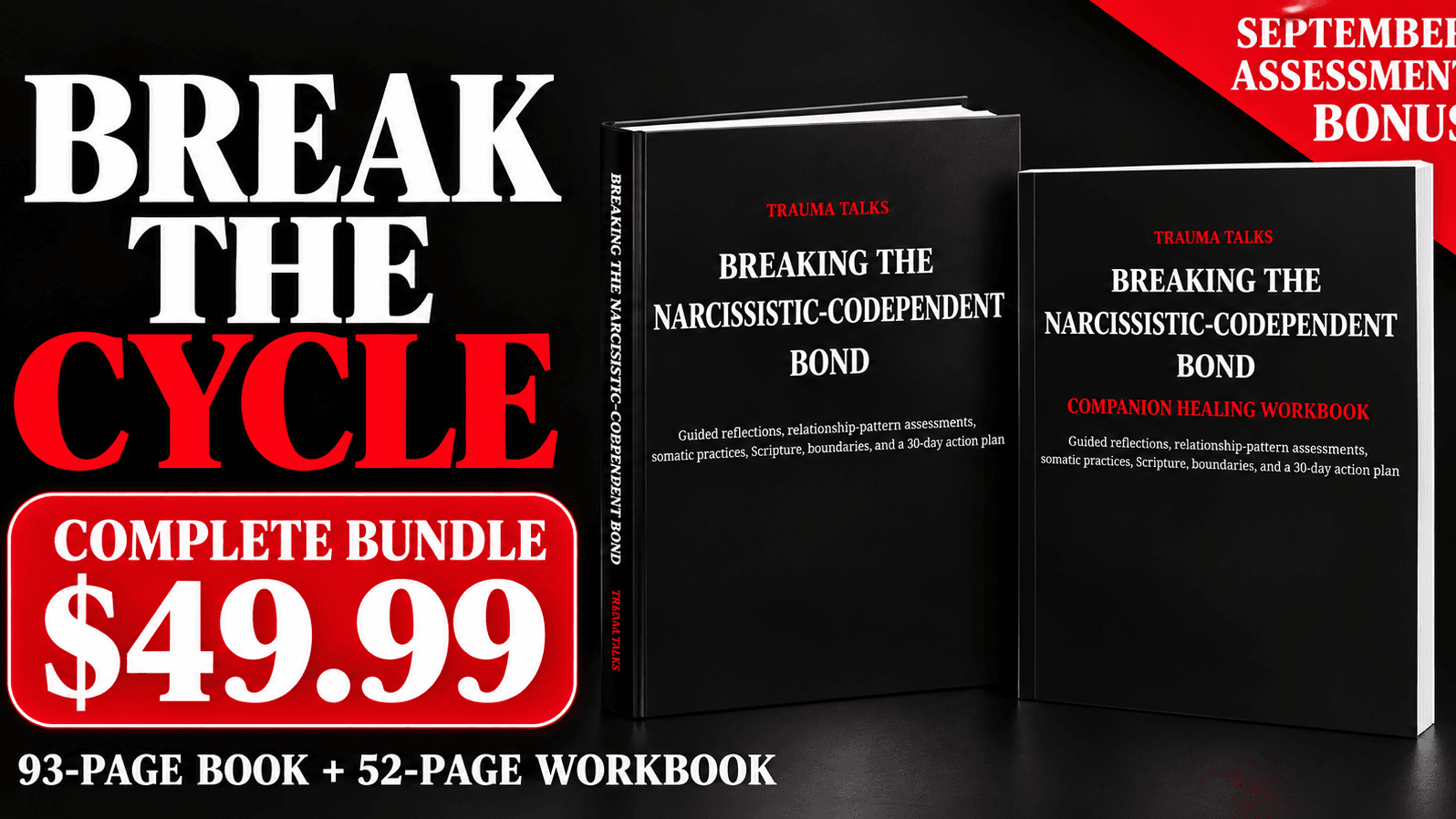
Breaking The Narcissistic-Codependent Bond
$49.99$59.99
BREAKING THE NARCISSISTIC-CODEPENDENT BOND
Complete Book and Companion Healing Workbook Bundle
$49.99
Faith-Integrated Psychology, Neuroscience, Somatic Healing, and Family-Systems Education
YOU ALREADY RECOGNIZE THE PATTERN. NOW IT IS TIME TO BREAK THE CYCLE.
You can know that a relationship is unhealthy and still feel emotionally pulled back into the same cycle.
You may keep explaining yourself, hoping the other person will finally understand. You may take responsibility for everyone’s emotions, rescue people from the consequences of their choices, or give away your boundaries to keep the peace.
You may leave emotionally—and then return when the conflict stops, the apology comes, or the person promises to change.
This does not mean you are weak.
Repeated cycles of fear, conflict, relief, affection, guilt, hope, and disappointment can condition the nervous system to experience instability as connection. The peaceful moments can feel especially powerful because your body has been waiting for the distress to end.
Breaking the Narcissistic-Codependent Bond was created to help you understand that cycle and begin practicing a healthier response.
This complete digital bundle gives you both the education and the practical healing work.
WHAT YOU WILL RECEIVE
1. THE COMPLETE 93-PAGE HEALING GUIDE
Breaking the Narcissistic-Codependent Bond is a detailed, faith-integrated guide that helps you examine destructive relationship patterns without using clinical labels as weapons.
The book explores:
• The biblical relationship and family-system patterns found in the story of Ahab and Jezebel
• Narcissistic defenses, including entitlement, control, blame-shifting, image protection, withdrawal, and retaliation
• Codependent survival patterns, including rescuing, appeasing, overfunctioning, overexplaining, and self-abandonment
• The nervous system and trauma bonding
• Why emotional relief can be mistaken for love, safety, or compatibility
• The difference between remorse, promises, and lasting transformation
• The effects of coercive control, silence, triangulation, and unequal power
• Boundaries, communication, accountability, and repair
• Faith without spiritual bypassing
• The difference between forgiveness, trust, access, and reconciliation
• Discernment about staying, separating, or ending contact
• Rebuilding identity, self-trust, and secure connection
• Relapse prevention and creating a healthier life
THE AHAB-JEZEBEL PATTERN AS A FAMILY SYSTEM
This book does not reduce the problem to two individual personalities.
It explains how an entire family can become organized around power, fear, control, passivity, secrecy, rescuing, image protection, and unequal responsibility.
One person may dominate or retaliate.
Another person may avoid responsibility while still benefiting from the outcome.
Someone else may rescue, carry messages, conceal the truth, or protect the family’s public image.
The person who names the problem may become the scapegoat.
Children may become peacekeepers, emotional caretakers, high achievers, invisible children, messengers, or constant observers of adult moods.
The guide also explains how systems surrounding the family—including extended family, churches, schools, workplaces, healthcare providers, courts, child-welfare agencies, and community networks—can either reinforce the destructive pattern or help interrupt it.
The goal is not to ask only, “Who is the narcissist?” or “Who is the codependent?”
The deeper questions are:
• Who has the most power?
• Who benefits from the pattern?
• Who carries the emotional, physical, financial, or spiritual cost?
• What happens when someone says no?
• How are children and vulnerable family members affected?
• Who protects the family’s image instead of protecting the people being harmed?
• Does the person causing harm accept responsibility and demonstrate consistent change?
2. THE COMPLETE 52-PAGE COMPANION HEALING WORKBOOK
Understanding the cycle is important, but insight alone does not automatically change a nervous-system response that has been practiced for years.
The Companion Healing Workbook helps you turn what you learn into structured, repeatable action.
The workbook includes:
• A personal baseline assessment
• Ahab-and-Jezebel family-system reflection exercises
• Questions that help you identify power, silence, rescuing, control, and responsibility
• Exercises examining how the family is affected
• Reflection on the larger systems surrounding the family
• Twelve weeks of guided healing work
• Nervous-system and somatic check-ins
• Trauma-bond awareness exercises
• Reality-testing and grief work
• Self-empathy practices
• Boundary-development exercises
• Ready-to-use communication scripts
• Accountability and repair tracking
• Faith-based reflection without spiritual bypassing
• Discernment exercises for staying, separating, or ending contact
• Identity and secure-connection exercises
• Relapse-prevention planning
• A personal safety and support plan
• A 30-day healing action plan
• A 90-day healing covenant
THE 12-WEEK HEALING PROCESS
Week 1: Name the System Without Losing Your Humanity
Week 2: Understand Narcissistic Defenses
Week 3: Understand Codependent Survival
Week 4: Regulate the Nervous System and Trauma Bond
Week 5: Restore Reality, Grieve, and Practice Self-Empathy
Week 6: Build Somatic Stabilization
Week 7: Use Boundaries and Communication Wisely
Week 8: Require Accountability and Repair
Week 9: Practice Faith Without Spiritual Bypassing
Week 10: Discern Whether to Stay, Separate, or End Contact
Week 11: Rebuild Identity and Secure Connection
Week 12: Prevent Relapse and Build a New Life
THIS BUNDLE MAY BE FOR YOU IF:
• You know something is wrong but continue doubting your perception
• You repeatedly explain yourself because you want to be understood
• You feel responsible for preventing another person’s anger, withdrawal, or disappointment
• You rescue people from the consequences of their behavior
• You confuse another person’s distress with proof that you have done something wrong
• You feel guilty when you establish a boundary
• You return to the relationship when the conflict stops or affection returns
• You have difficulty separating forgiveness from restored access
• You want to understand how these patterns affect the entire family
• You want faith-based healing that does not excuse abuse or erase accountability
• You are ready to stop measuring change by apologies, tears, gifts, promises, or religious language
• You want a structured plan for rebuilding your identity, boundaries, and self-trust
WHAT THIS BUNDLE WILL HELP YOU DO
This book and workbook will help you:
• Recognize the repeating cycle instead of focusing only on the latest argument
• Separate observable facts from promises, hopes, and manipulation
• Understand what your nervous system is trying to protect
• Identify the responsibilities that belong to you
• Stop carrying responsibilities that belong to another adult
• Recognize control, passivity, rescuing, triangulation, and scapegoating
• Understand how destructive patterns affect children and the entire family
• Develop clearer and safer boundaries
• Respond to guilt, fear, grief, and urgency with greater awareness
• Evaluate repentance through consistent behavior over time
• Integrate faith with truth, wisdom, accountability, and protection
• Create a practical plan for your next stage of healing
THIS IS NOT ABOUT LABELING PEOPLE
Narcissistic traits exist on a spectrum. Narcissistic Personality Disorder is a clinical diagnosis that must be made by a qualified professional after an appropriate assessment.
Codependency is a widely used relationship concept, not a formal DSM diagnosis.
This resource focuses on observable behavior, power, impact, safety, responsibility, and the capacity for repair.
The biblical story of Ahab and Jezebel is used as a relational, spiritual, and family-system case study. It must not be used as a gendered insult, a weapon, or a substitute for clinical assessment.
A strong or assertive woman is not automatically “a Jezebel.”
A passive or dependent person is not automatically innocent or powerless.
The important questions concern behavior, responsibility, impact, safety, and sustained change.
FAITH THAT MAKES ROOM FOR THE WHOLE TRUTH
Faith should never be used to pressure someone to remain silent, ignore evidence, tolerate abuse, remove necessary consequences, or restore access before trust has been rebuilt.
Forgiveness is not the same as trust.
Forgiveness is not the same as access.
Forgiveness is not the same as reconciliation.
Reconciliation requires truth, consent, safety, accountability, and sustained participation from everyone involved.
Healthy faith makes room for grief, anger, boundaries, wise counsel, professional support, protection, and observable fruit.
DIGITAL PRODUCT
This is a digital bundle. No physical book will be mailed.
Your purchase includes downloadable PDF copies of:
• Breaking the Narcissistic-Codependent Bond
• The Companion Healing Workbook
You may save and print the materials for your personal use. The files may not be copied, shared, resold, reproduced, uploaded, or distributed to other people.
IMPORTANT SAFETY AND EDUCATIONAL DISCLAIMER
This bundle provides psychoeducation. It is not a diagnosis, psychotherapy, medical advice, legal advice, emergency care, a custody evaluation, or a forensic assessment.
The material does not promise that a particular relationship can or should be repaired.
If intimidation, stalking, strangulation, sexual coercion, weapon access, escalating violence, child abuse, financial control, or fear of retaliation is present, seek individualized assistance from a qualified abuse-informed professional.
Do not announce a new boundary, departure, or documentation plan when doing so could increase danger.
If you are in immediate danger, contact emergency services. In the United States, you may also contact the National Domestic Violence Hotline at 800-799-SAFE (7233), text START to 88788, or visit thehotline.org. Technology use may be monitored.
GET THE COMPLETE BUNDLE FOR $49.99
You do not need another promise that everything will be different.
You need truth, tools, support, and a practical plan that helps you make different choices.
Receive the complete 93-page book and the 52-page Companion Healing Workbook together for one price:
$49.99
GET THE COMPLETE BUNDLE
SEPTEMBER ASSESSMENT BONUS
Purchase the complete $49.99 bundle during September 2026 and receive a complimentary One-Day Healing Assessment with Krystal Boothe, LCSW.